














Be the first to comment
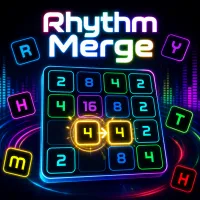
Rhythm Merge transforms the familiar 2048 formula into a colorful musical puzzle. Players must combine matching numbered tiles while timing each move to the beat, creating a challenge that tests both board management and rhythmic accuracy.
Developed by Joe Li using Unity, the game is currently in development and can be played in a browser or downloaded for Windows. Its neon interface, electronic soundtrack, and clear timing feedback complement its energetic gameplay.
Rhythm Merge takes place on a compact 4×4 grid. Pressing an arrow key slides every tile in the chosen direction. When two tiles with the same value collide, they merge into a larger number and increase your score.
A new tile appears after each valid move, gradually reducing the available space. You must keep matching values close together, preserve open cells, and consider how the entire board will change before pressing a key. The session ends when the grid is full and no further merges are possible.
Every movement must also match the music. A properly timed input earns points, while an inaccurate one produces a “Miss” message. Players can also press between two beats to perform a Bonus Hit, which doubles the points earned from that move.
This timing system adds an extra layer of difficulty because the best direction may not always be obvious when the next beat arrives. Quick observation and confident decisions become increasingly important as the board fills up.
The game offers several options for learning its mechanics and testing your timing:
The 60 BPM mode is a comfortable starting point for new players, while the experimental 100 BPM setting provides a more intense challenge.
Try 2048 6x6 for traditional tile merging on a larger board with more room to build high-value numbers.
2048 3x3 offers a smaller grid where limited space makes every movement important.
You can also play Swipe Sushi, a visual merging puzzle about combining matching sushi pieces and carefully managing the board.